
Know Your Agent (KYA): A Verification Framework for AI Agents
Know Your Agent (KYA) is a verification framework designed for autonomous AI systems.

The internet’s trust infrastructure was designed around a simple assumption: humans are the primary actors interacting with digital systems.
Most authentication and identity frameworks in use today reflect this model. Passwords, multi-factor authentication, OAuth flows, CAPTCHAs, device fingerprinting, and Know Your Customer (KYC) systems were all built to verify human users accessing platforms directly.
Autonomous AI agents are increasingly operating across applications, APIs, browsers, wallets, enterprise systems, and financial infrastructure. These systems can execute tasks, interact with services, manage workflows, and perform transactions with limited or no continuous human interaction.
Current internet infrastructure lacks a standardized framework for AI agent verification, AI agent identity, ownership, authorization, and accountability. Existing systems can authenticate credentials, but they often cannot determine who is responsible for the agent, whether a human approved an action, or what permissions the agent should operate under.
This creates a structural trust gap for autonomous systems operating across digital infrastructure. As AI agents become more capable and widely deployed, verification models designed exclusively for human users become increasingly insufficient. This has led to the emergence of a new framework: Know Your Agent (KYA).
What is Know Your Agent (KYA)?
Know Your Agent (KYA) is a verification framework designed for autonomous AI systems.
While traditional identity systems focus on validating human identities, KYA focuses on establishing trust, accountability, and authorization for AI agents operating on behalf of users or organizations.
A KYA framework is designed to answer four core questions:
- Is the agent linked to a verified human or organization?
- What permissions and scopes has the agent been granted?
- Was a specific action explicitly authorized?
- Can the activity be audited and attributed?
This differs from traditional authentication models.
Most existing systems verify whether credentials are technically valid. They do not evaluate whether an autonomous action should occur in the first place.
KYA introduces an additional accountability layer by establishing a verifiable relationship between agent activity and authorized human oversight.
Why KYC Doesn’t Work for AI Agents
KYC has historically served as one of the primary trust frameworks across financial services, online platforms, and digital infrastructure.
Banks, fintech applications, exchanges, and regulated institutions use KYC to verify human identities during onboarding and compliance processes.
However, KYC was developed for an internet where humans directly initiated most actions. Autonomous AI agents fundamentally change this interaction model.
Instead of users manually interacting with systems, AI agents are beginning to operate continuously across multiple environments. These systems can execute trades, coordinate workflows, interact with APIs, manage enterprise operations, and communicate with external services autonomously.
This introduces a limitation in traditional verification models.
KYC verifies the user during onboarding, but it does not continuously verify whether future autonomous actions remain authorized.
Once credentials are issued, systems generally assume subsequent activity is legitimate. In an environment increasingly driven by agentic AI and autonomous systems, that assumption becomes more difficult to maintain.
As AI-driven activity continues to scale, verification systems designed primarily for human interaction provide limited visibility into autonomous behavior.
Existing authentication standards such as OAuth 2.0 and API key infrastructure were not originally designed for persistent AI agent verification or machine identity management. Similarly, many existing compliance frameworks focus on verifying users rather than validating ongoing authorization for autonomous systems.
This creates a growing need for verification infrastructure designed specifically for non-human identity and AI agent accountability.
KYA vs KYC: What’s the Difference?
Traditional Know Your Customer (KYC) systems were designed to verify human users during onboarding. Know Your Agent (KYA) extends verification to autonomous AI systems operating continuously across digital infrastructure.
While KYC validates a person’s identity, KYA focuses on verifying AI agent ownership, authorization scope, and accountability throughout the agent lifecycle.
| KYC | KYA | |
|---|---|---|
| Focus | Verifies human identity | Verifies AI agent identity and ownership |
| Timing | Primarily onboarding-focused | Continuous operational verification |
| Designed for | Human actions | Autonomous AI systems |
| Validates | Credentials | Authorization and approval |
| Orientation | Focused on compliance | Focused on accountability and trust |
| Interaction model | Human-to-platform interactions | Agent-to-system interactions |
As autonomous AI agents become more common, organizations increasingly require both KYC and KYA frameworks operating together.
The Emergence of the Agentic Internet
The internet is gradually shifting toward what many describe as an “agentic internet,” where AI systems increasingly act as intermediaries between users and digital services.
In this environment, autonomous AI agents may manage financial operations, coordinate enterprise workflows, automate customer interactions, interact with decentralized infrastructure, or operate across multiple services simultaneously.
This changes the operational trust model of the internet.
Platforms are no longer authenticating only human users. They are increasingly authenticating autonomous software acting on behalf of humans.
Without appropriate AI agent verification infrastructure, platforms face two undesirable outcomes:
- Restrict automation entirely, limiting operational efficiency and innovation
- Allow autonomous systems to operate without meaningful accountability controls
Neither approach scales effectively.
A standardized framework is required to verify that autonomous systems are legitimate, appropriately authorized, and operating within defined constraints.
KYA is designed to address this problem.
Core Use Cases for KYA
KYA infrastructure becomes increasingly relevant in environments where AI systems operate autonomously or interact with sensitive infrastructure.
Financial Services and Payments
AI agents are beginning to participate in trading systems, payment orchestration, and financial automation.
In these environments, organizations need mechanisms to verify whether transactions were authorized by legitimate users and whether autonomous systems remain within approved operational boundaries.
KYA frameworks can support authorization controls, spending limits, approval policies, and auditable attribution for agent-driven financial activity.
Enterprise Systems
AI copilots and enterprise agents increasingly interact with internal systems, operational infrastructure, and sensitive company data.
Organizations require visibility into:
- Which employee or department authorized the agent
- Which systems the agent can access
- What actions require explicit approval
- Whether activity complies with internal governance policies
These controls become particularly important as enterprise AI systems gain broader operational autonomy.
Crypto Infrastructure
Autonomous wallets, AI trading systems, and onchain agents are becoming more common within decentralized ecosystems.
KYA introduces a framework for linking autonomous blockchain activity to verified human accountability while maintaining operational flexibility for agent-driven systems.
This creates stronger trust guarantees for autonomous financial coordination and machine-driven transactions.
APIs and Autonomous Services
AI systems increasingly interact directly with APIs, cloud infrastructure, and external services.
In these environments, platforms require machine-readable methods for verifying AI agent legitimacy, authorization scope, and operational accountability across systems.
KYA provides a portable trust framework designed to operate across multiple applications, environments, and infrastructures.
How AG9 Implements KYA Infrastructure
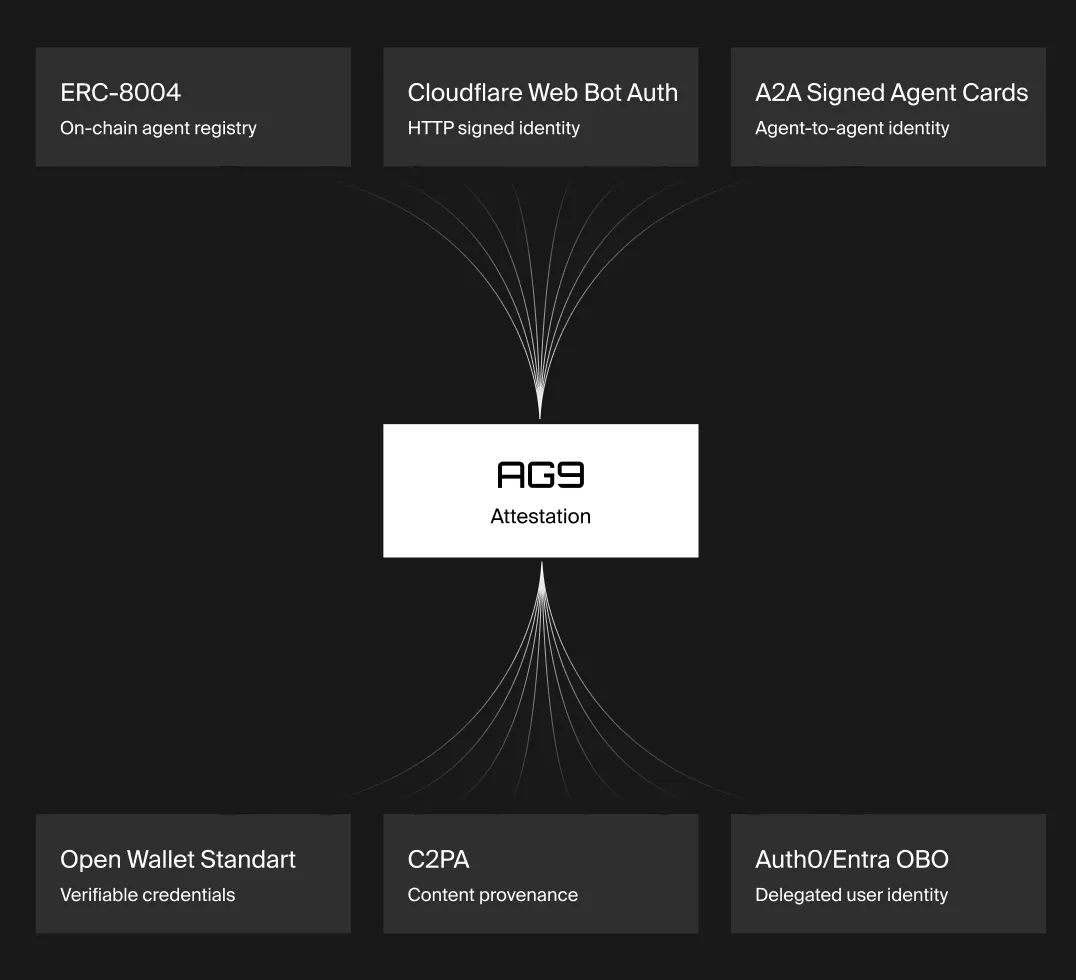
AG9.ai by VeryAI is designed as an implementation layer for KYA infrastructure.
The system introduces a human-bound verification model for AI agents using palm biometrics as a mechanism for persistent identity binding.
Rather than replacing existing authentication infrastructure, AG9.ai integrates alongside commonly used systems such as OAuth, API keys, signed requests, identity providers, and agent frameworks.
These systems already provide authentication and access management capabilities.
However, they generally do not verify whether autonomous actions remain tied to authorized human approval.
AG9 introduces an additional verification layer designed to establish a persistent relationship between:
- A verified human identity
- A specific AI agent
- Defined permission scopes
- Explicitly approved actions
This allows platforms to evaluate not only whether an agent is authenticated, but also whether its activity is operating within approved authorization boundaries.
The objective is to introduce stronger accountability and attribution controls for autonomous systems without disrupting existing infrastructure.
Frequently Asked Questions About Know Your Agent (KYA)
What is Know Your Agent (KYA)?
Know Your Agent (KYA) is a verification framework for autonomous AI systems. It establishes accountability, ownership, authorization scope, and approval mechanisms for AI agents operating across digital infrastructure.
How is KYA different from KYC?
KYC verifies human users, while KYA verifies AI agents and their relationship to authorized human operators. KYA focuses on continuous agent accountability rather than only onboarding identity checks.
Why do AI agents require verification?
Autonomous AI agents can operate independently across APIs, enterprise systems, wallets, and financial infrastructure. Without verification systems, platforms cannot reliably determine ownership, authorization, or accountability for agent actions.
What is AI agent verification?
AI agent verification refers to systems designed to validate the identity, authorization scope, and operational legitimacy of autonomous AI agents interacting with digital infrastructure.
Can KYA work alongside existing authentication systems?
Yes. KYA is designed to complement existing systems such as OAuth, API keys, identity providers, and signed requests by adding a persistent accountability and authorization layer for autonomous AI systems.
Ready to verify your agents?
Bind every agent action to a verified human with AG9.